

Yves Tanguy
1927
Yves Tanguy
1940
Yves Tanguy
1945
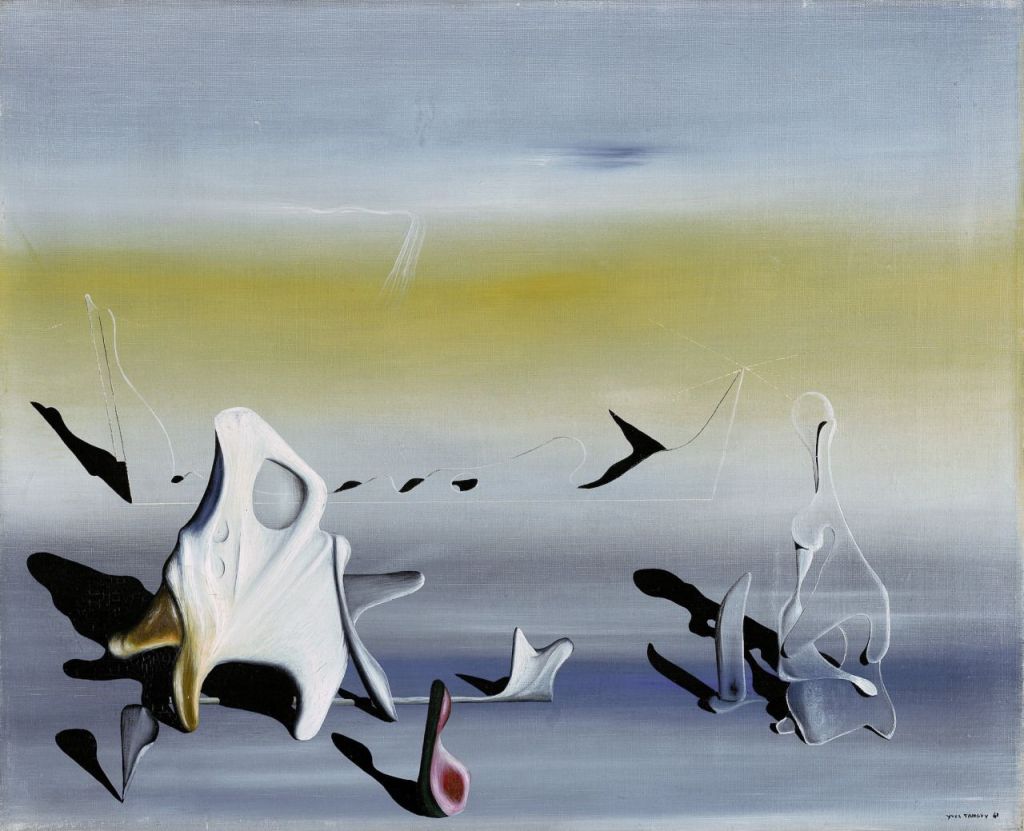
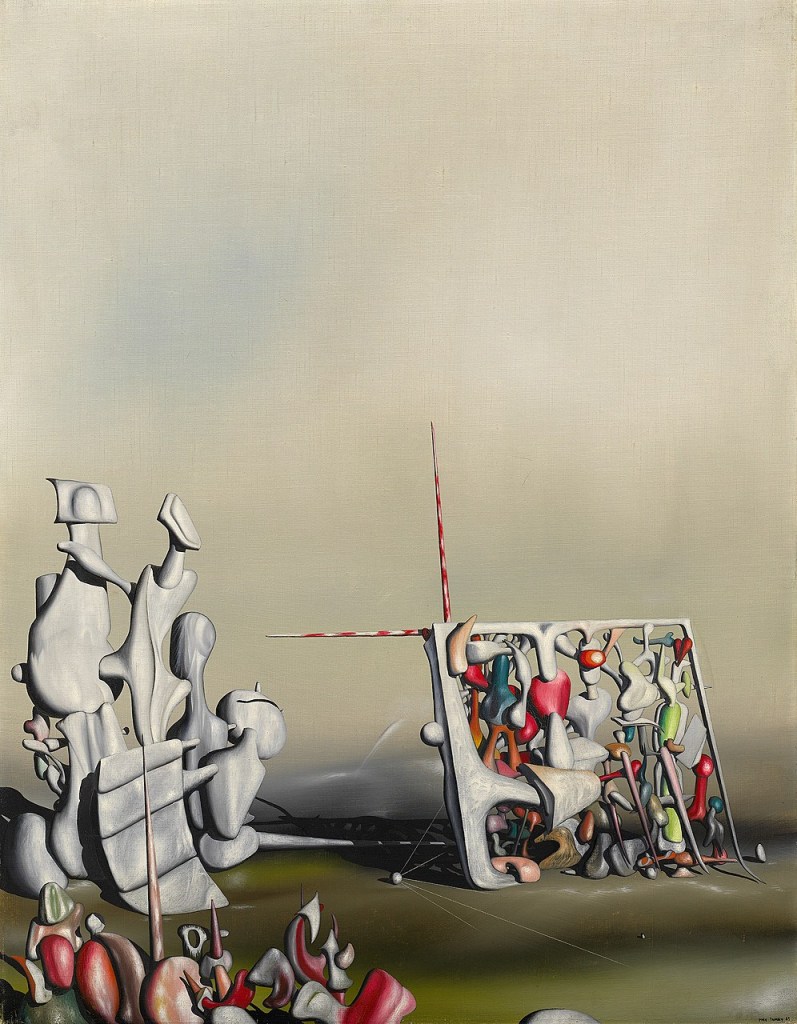
Tanguy conjures expansive, non-representative, surreal landscapes. Within the composition, carefully placed shapes interact and allude to the human form, such as the group of towering grey figures in the left hand side of There, Motion has Not Yet Ceased. They appear to be threatened by the candy-cane coloured spear and you can distinguish a figure in the centre of the group that defiantly turns towards the aggressor and seems to protect the other ghostly white forms. He uses an interesting mix of geometric and organic, but consistently alien, shapes that makes for a dynamic and interesting scene. But what does this scene mean? …
Born in 1900, Raymond George Yves Tanguy (known in the art world as Yves Tanguy) made an entrance into André Breton’s famous Surrealist circle during the first half of the 20th Century, having been introduced by his friend Jacques Prévert. Tanguy gave his first solo exhibition in Paris in 1927 and established himself with a unique style. Throughout his life, he had three main relationships: the first with Jeannette Ducrocq whom was his wife for a period. The next, a passionate affair with the successful art collector Peggy Guggenheim and finally, he fostered a realtionship with a fellow surrealist Kay Sage, whom he followed to New York after the outbreak of World War II. Tanguy had a distinct, recognisable style that remained constant as he aged and emigrated from Paris to the US.
The image below is of Tanguy’s 1942 painting Indefinite Divisibility, completed following his move to the States.

Yves Tanguy
1942
Indefinite Divisibility is a quintessential example of Tanguy’s work is its provision of different iterations of contradictions, mystery and of alien landscapes. Whilst posing metaphysical questions, the viewer is left confused and, most crucially, remains a viewer, as Tanguy does not give them the key into his world.
In the foreground, a series of both geometric and organic shapes interact, constituting an elaborate piece of machinery that is reminiscent of a child’s marble-run. The colour palette is tight and the colours used are consistent throughout the composition, save for the dark, flat shadow cast by the contraption onto the background. The vast, open space (that is typical of Tanguy’s work) into which the shadow advances, is intended to represent the mind. Here we can identify another curious contradiction; Tanguy depicts the immaterial and abstract realm of the mind through empirical means. The composition alludes to a great depth, however the background is simple and lacks a distinct horizon, instead a vibrant swipe of blue. Nevertheless, Tanguy manages to create the impression of an expansive unknown. The ‘unknown’ does not seem overtly menacing as the colours used are comparatively light, yet the cool tones are alien and create a sense of unsettlement.
Notably, Tanguy uses obscure shapes and symbols without a clear meaning. Normally, artists such as Dalí (whom is notorious for his motifs) use symbols and motifs with a clear corresponding meaning. For example, Dalí uses melting clocks to represent the omnipresence of time or draws to imply the release and acceptance of a woman’s secrets and sexuality (an idea deriving from Freud’s explanation of the concealed sexuality of women). However, Tanguy’s message remains a secret, perhaps contributing towards his failure to capture the attention of the public. He makes it difficult for them as they are not able to enter into his artistic process and understand his intentions. For this reason, his work is frustrating.
Overall, the composition raises complex metaphysical questions. Perhaps the shadow is used to demonstrate an individual’s perception of the stimulus/contraption? If so, are we unable to conceive of the real world in its full vibrancy? Is the title a reference to the irreducibility of the mind and the uncertainty that it carries?
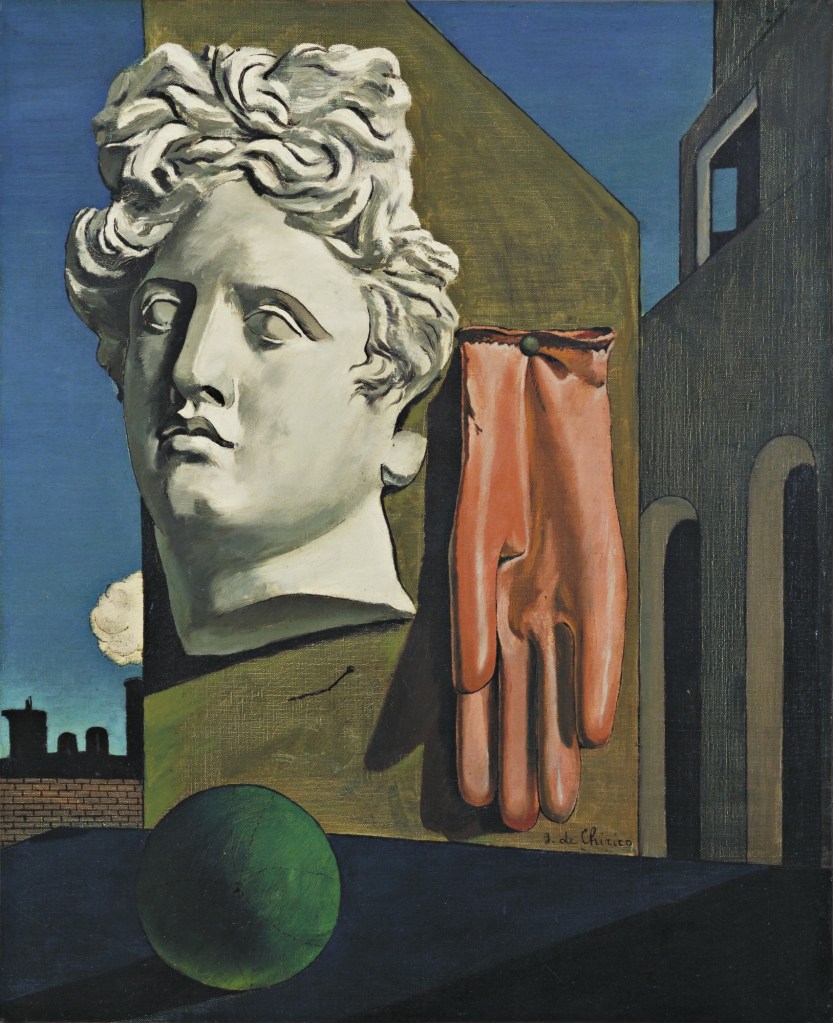
These questions lie unanswered, by we an acknowledge that Tanguy took inspiration from Giorgio de Chirico. After returning from his military service in 1922, Tanguy returned to Paris where he made a living doing odd jobs until he encountered a painting by Chirico, that touched him so profoundly he decided to become a painter himself. Below are two examples of Chirico’s work:

Giorgio de Chirico
1917
Giorgio de Chirico
1914
There are clear parallels between the two artists where Tanguy has drawn inspiration, particularly in the totem pole-esque structures and architectural themes. Both create figures from an amalgamation of abstracted objects. It is reasonable for us to conclude that Tanguy wishes to raise the same metaphysical questions as Chirico.
Finally, do you think it is important for art to have a clear meaning? Especially if it is as philosophically charged as the work by Yves Tanguy?
 Squamlette