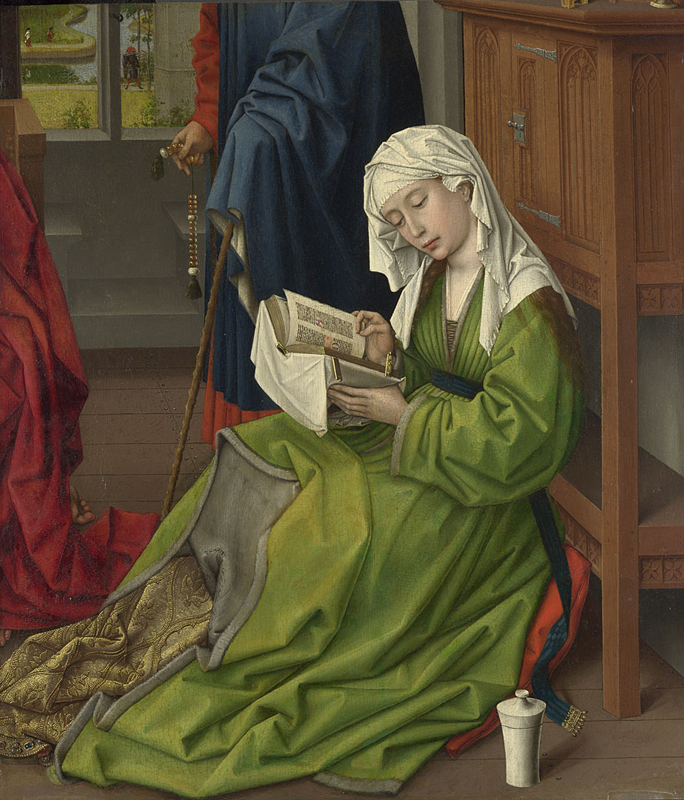
Upon leaving the National Gallery’s 1250-1400 collection, The Magdalen Reading[1], c.1438, by Rogier van der Weyden caught my attention. The close-up, even claustrophobic, view of a woman reading surrounded by cropped figures contradicted my understanding of the composition and subject matter common for Early Netherlandish religious scenes, normally depicting several full figures. Indeed, this obscurity in the composition was explained as the painting had been cut from an altarpiece said to depict the Virgin and Child with Saints[2] that is now disassembled and partially lost.
Having previously studied van der Weyden’s Descent from the Cross[3], c.1435, I was surprised to find Mary Magdalene to be such a peaceful and candid subject. Although only appearing elusively in the scriptures, Mary Magdalene has become conflated with other female figures. The earlier emphatic and anguished depiction seemed consistent with the pejorative portrayal of Mary as promiscuous and the antithesis of virtue and purity. Explored through the exposure of her skin, outline of her body through her clothes and angular positioning of her arms, Mary Magdalene is portrayed in The Descent from the Cross as somewhat imperious.
In contrast, in The Magdalen Reading, Mary appears as almost angelic and the scene is permeated with an atmosphere of tranquillity. The composition is dominated by the semi-circular green dress of the seated Mary and the shape is repeated in her sleeve. The refined echoing of shapes, together with van der Weyden’s characteristic geometric composition, create rhythm and harmony and a certain softness that gently invites consideration of Mary’s contemplation.
The sense we are given is of her piety and repose, and van der Weyden uses contrast to accentuate her delicate features. For example, the weight of the heavy, almost sculptural folds of her attire, typical of Northern 15th century dress, highlight the lightness of her form. This is also achieved by a feeling of voyeurism brought about by the contrast between the dark looming figure of St Joseph[4] against Mary’s state of quiet reflection, apparently detached from her surroundings. Her gently sloping nose, sweet chin and soft hands are more reminiscent of an angel than a prostitute.
I feel a great degree of intimacy with this work, perhaps due to the Flemish style of depicting religious figures in everyday situations, with a fidelity to realism and immense detail; a technique inherited from the tradition of manuscript painting in the Low Countries and the treatment of the text in the book is evidence of this. Her dignified, downturned, oval eyes and her luxurious surroundings, such as the fur, gold, wood and ceramic, endow her with a sort of nobility. The result is palpable; Mary has the essence of a real woman with an inescapable quiet force.
That said, Mary is not without reminders of her degenerative past. Her identifiable alabaster jar of ointment sits in the foreground, casting a heavy shadow. The point of contact between the edge of her dress and the solid alabaster jar further emphasises its presence. Similarly, her exposed hair falls in curls from under her loose headscarf, referencing the sinner who wiped her tears off Christ’s feet with her hair. The upturned skirt, signalling to the carnal, reveals a decadent golden brocade underskirt and the rich green of her dress is the colour associated with fertility. These sexual references imply that Mary cannot regain her innocence, however much van der Weyden presents her previously wild sexuality as domesticated.
In conclusion, with the loss of most of the altarpiece, a full assessment of the van der Weyden’s intentions is limited, and the question remains: is he aiming for the absolute reconciliation of female sexuality with piety, shown by Mary’s demure repose? I wonder whether this can be the case considering the ecclesiastical role of the altarpiece, the use of her traditional attributes and the scathing portrayal of Mary typically adopted by the Church. She has been long established as the epitome of female immorality, as set by the male dominated Church and perpetuated by the similarly male dominated art world. So, it is perhaps ironic that the best surviving panel of the altarpiece is of Mary Magdalene herself.
[1] R. van der Weyden, The Magdalen Reading [Oil on mahogany], c.1438. The National Gallery, London.
[2] Wikipedia, The Magdalen Reading [website], https://en.wikipedia.org/wiki/The_Magdalen_Reading#cite_note-C49-23, (accessed 15 October 2020).
[3] R. van der Weyden, The Descent from the Cross [Oil on oak], c.1435. Museo del Prado, Madrid, https://en.wikipedia.org/wiki/The_Descent_from_the_Cross_(van_der_Weyden)#/media/File:Weyden_Deposition.jpg, (accessed 18 October 2020).
[4] Wikipedia, The Magdalen Reading.
 Squamlette
#/media/File:Weyden_Deposition.jpg)